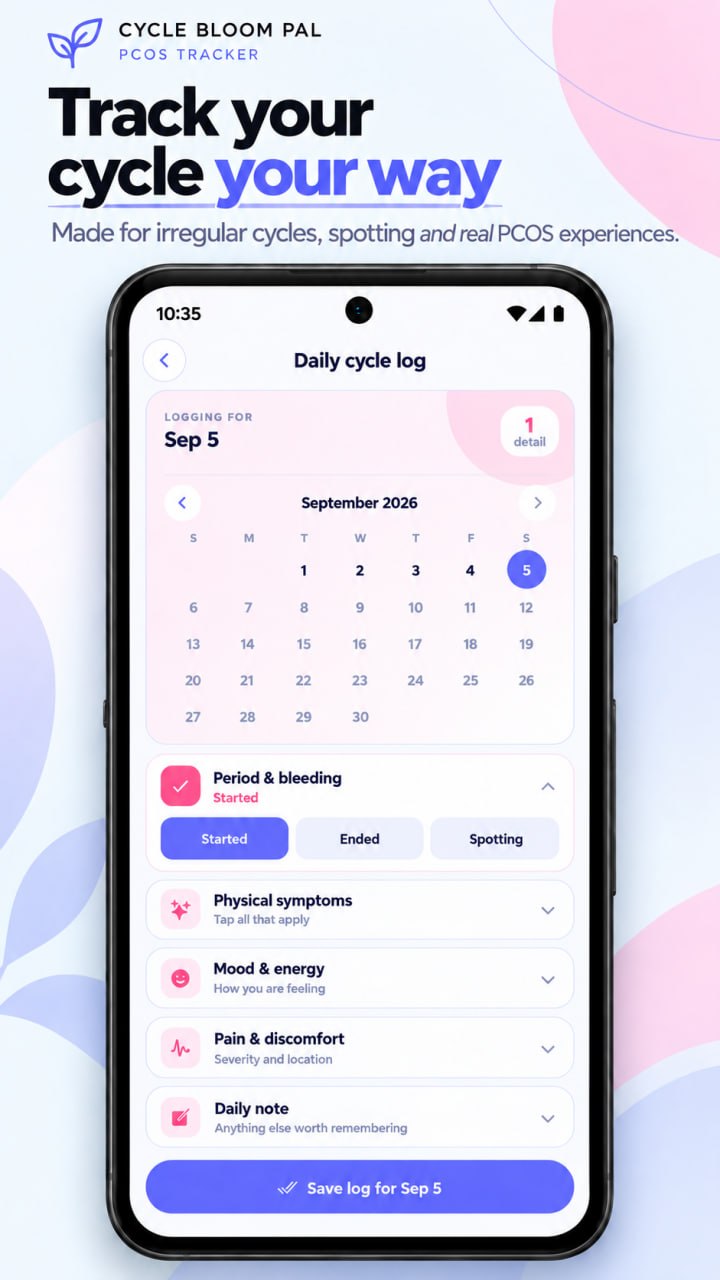
Tracking irregular periods with PCOS is most useful when it records what happened, rather than trying to force your cycle into a prediction. Dates, bleeding notes, and the effect on your day can support a conversation with a clinician. A perfect calendar is not required.
If you have ever opened a tracker and felt that your cycle was “wrong” because it did not match the expected date, start with a different goal: create a record you can trust. This guide shows how to do that in Cycle Bloom Pal without guessing missing information or treating predictions as medical findings.
Count the cycle you observed
The first day of a menstrual cycle is the first day of a period. A cycle runs to the day before the next period starts. The NHS guide to irregular periods explains the value of keeping a diary or using an app to see patterns.
If you are uncertain whether light bleeding was a period or spotting, record what you actually saw and note your uncertainty. Ask your clinician how they would like you to classify it for the purpose of your care. You do not need to decide what it proves.
Keep period dates separate from an app’s predicted dates. A forecast can change as information is added. Your observed entry should remain an account of the event, not be moved to fit the prediction.
The smallest useful record
Start with a few details that answer a question you care about. Here is a simple structure you can adapt:
| Record | Example | Why keep it? |
|---|---|---|
| Date | Bleeding began on the 8th | To identify the timing |
| Description | Spotting; unsure if a period | To preserve what you observed |
| Duration | Still bleeding the next day | To avoid relying on memory later |
| Impact | Interrupted work twice | To explain the effect on daily life |
| Question | Should I classify this differently? | To make the next appointment more focused |
The examples are illustrative, not a standard for what your bleeding should look like. Choose consistent language that makes sense to you. A clinician can help interpret the information later.
How to log a day in Cycle Bloom Pal
- Check the date. In the daily cycle log, make sure “Logging for” refers to the day you intend.
- Add bleeding information when relevant. The screen shown on our website offers Started, Ended, and Spotting under Period & bleeding.
- Add the details you want to remember. Physical symptoms, mood and energy, and pain and discomfort can provide context.
- Use the daily note. A short phrase can capture uncertainty or the effect on your day.
- Save the entry. Recheck the date before finishing, especially if you are recording yesterday’s events.
Labels may differ with the version or language of the app. The important part is accurate dating and a description you will understand when you read it again.
What to do about missed entries
If you remember an event but not its exact date, say so. If you do not remember it at all, leave the gap. An empty field is different from a confirmed “no symptoms” entry.
For example, “I noticed spotting sometime over the weekend; the exact day is uncertain” preserves information without false precision. Do not choose a date only because the app suggests that a period should have happened then.
You also do not need to spend an evening reconstructing months of data before restarting. Begin today and add older information only when you are confident about it. Consistency from now on can be more useful than an elaborate but unreliable backfill.
Review a pattern without claiming a cause
At a planned review, ask three questions: what did I record, what remains uncertain, and what do I want to ask about? You can notice that discomfort and bleeding were recorded together without concluding why.
A practical summary might be: “I have reliable start dates for two periods, one uncertain episode of spotting, and a gap in the record while travelling.” That is a clearer account than “My tracker says my hormones are unbalanced.”
Do not use the record as a fertility test. Cycle predictions do not confirm ovulation, and Cycle Bloom Pal is not intended to prevent or achieve pregnancy. Discuss contraception or fertility goals with a qualified professional.
When an irregular cycle deserves a conversation
PCOS can be part of the explanation for irregular periods, but it is not the only possible cause. Pregnancy, medicines, life-stage changes, and other conditions can also be relevant. The NHS missed-period guidance recommends seeing a GP after three missed periods in a row, or for other concerning changes.
If pregnancy is possible, follow appropriate pregnancy-testing advice rather than assuming a late period is your usual PCOS pattern. You can ask your clinician what follow-up makes sense for your circumstances, especially if bleeding has been absent for a long time.
Do not wait for a routine app review if you have severe or worsening pain, feel faint, or have heavy bleeding with pelvic pain. The NHS pelvic-pain resource describes situations requiring urgent or emergency assessment. Use the equivalent service where you live.
Prepare a short summary for an appointment
Bring the reliable dates, the uncertain parts, and the one question you most want answered. Mention how symptoms affect activities rather than relying only on labels such as mild or severe. If you started a medicine or contraception, include that context without assuming it explains everything.
The appointment preparation guide includes a one-page format. If you are still learning what the condition means, read PCOS basics; if predictions have created confusion, see the PCOS myths guide.
Start with the facts: use Cycle Bloom Pal to save one accurate entry rather than chase a perfect streak. Tracking supports communication; it does not diagnose the cause of bleeding or replace medical care.